 |
| Hello everyone!! This week I want to share a photo I took at the Oeam Folk Village in Asan, South Korea. This photo is showing part of the process for how people in ancient Korea during the Joseon dynasty would have done their laundry. After washing in the river, people in ancient Korea would pound the clothes repeatedly with the sticks to flatten or iron out the clothes. Pretty neat right? |
Friday, October 25, 2019
Photo of the Week #4

Sunday, October 20, 2019
Wishing Rocks, Korean Sushi, and Climbing Mountains
Hello Everyone!
I really hope you all enjoyed my post about Korean food last week! Which one was your favorite to learn about? Are there any Korean foods you know that you wish I talked about? I think my favorite was the seaweed soup because not only is it healthy for you, I think its really neat that it has such an interesting cultural meaning behind it too.
This week I am going to talk about a fun activity I did recently with some friends and teach you about the culture surrounding this activity. First, I am going to show you a picture from this activity. Can you guess what activity I may have been doing?
 |
| Picture I took overlooking part of the peak at Bukhan Mountain (북한산-book-han-san) |
 |
| A map of Bukhansan relative to Seoul |
My friends and I took the subway from our university in Suncheon to Seoul on Sunday, October 13th which was about a 3 hour subway ride. We left early in the morning but after some troubles we didn't get started until about 11am. The hike was going supposed to be around 5 hours long which worked well considering the park closed at 5pm. Luckily the weather was perfect that day. Hiking is definitely most popular in the fall since in Korea the fall is less rainy and it is not as hot as the summer.
 |
| My friends and I during our hike. This picture was taken about 3 hours in or halfway through. |
The first thing I noticed when we were hiking was how young we all were compared to the rest of the hikers. In America, hiking is often an activity for people of all ages (but especially younger kids). However, in Korea hiking is typically done by older Koreans in their 40s-70s. When I asked my Korean friends about this they said that the older Koreans find it to be the best way to connect with their friends and get some healthy exercise in at the same time. Unlike younger people who prefer to go out with their friends at the movies, karaoke rooms, clubs, or video game cafes.
 |
| Group of Koreans getting ready to start their hike. Aren't their outfits super colorful? |
Remember how last week we talked about different foods that have cultural meaning? Hiking has one too! When I learned about hiking in Korea, my Korean teacher explained that the #1 food to eat when hiking is 김밥 (kim-bap) or Korean sushi. It is similar to Japanese sushi, except it doesn't contain raw fish, and mostly has vegetables. The most classic kimbap contains spam or bulgogi, rice, seaweed, pickled radish, carrots, and spinach. It is super delicious so my friends and I definitely brought some with us. I also wasn't surprised when I saw the countless kimbap stands surrounding the mountain. There was even a man selling fresh kimbap straight out of his van!
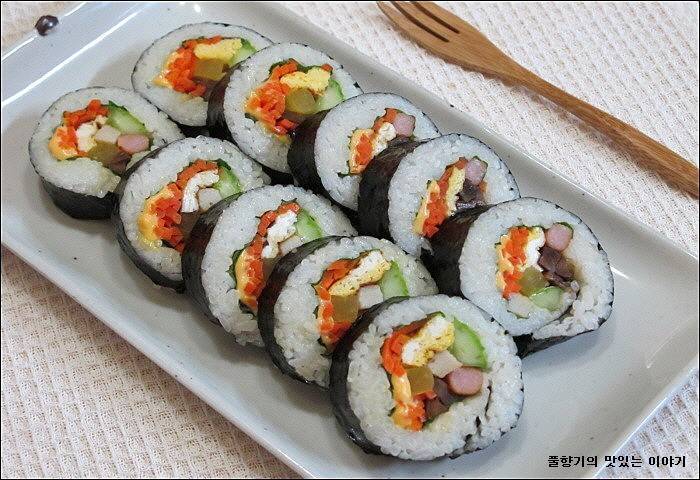 |
| Example of some kimbap. |
Hiking in Korea isn't only great exercise, it is also a great way to see some neat historical sites from Ancient Korea. While we were hiking we saw two different historical buildings. One was a gate built in the Joseon dynasty and the other was a little shrine also built during the Joseon dynasty. The mountains is also where most of the buddhist temples and monasteries are so you will often see people dressed in traditional religious attire while hiking (such as buddhist monks).
 |
| Shrine we saw while hiking. |
Before hiking my Korean Culture and Society professor also talked to us about these stone formations you can often come across while hiking. They basically just look like stacks of rocks. However, my teacher explained they have another purpose beyond looking pretty. It actually turns out they are wishing rocks! This means that when you add a new rock to the pile you make a wish and hopefully it will come true. I came across quite a few on our hike and tried to make a wish each time. Since the hike was pretty tough and I was getting pretty tired, most of my wishes ended up being about finishing the hike successfully. Do you know of any traditions in America where we make wishes? The first one I can think of is dandelions! I remember whenever I saw a dandelion as a kid I would blow the thistles, close my eyes, and make a wish.
 |
| A smaller rock formation I saw while hiking. |
 |
| A large stack of rocks we found near the ancient Korean gate! How many wishes do you think have been made here!? |
 |
| View of one of the peaks at the mountain. Unfortunately we ran out of time to go up there. Can you spot the people climbing? |
 |
| Another view of the mountain. Can you spot the city in the background? We were pretty high up huh? |
As always, I would love to hear all of your thoughts below and if you have any ideas for upcoming posts! This week is midterms (big tests you take during the middle of the semester in college) so I think I will go back to studying now! Have a great week everyone!
다음에 봐요 (da-eum-eh bwa-yo)! Until next time!
다음에 봐요 (da-eum-eh bwa-yo)! Until next time!
Thursday, October 17, 2019
Photo of the Week #3

This week I want to share a picture I took of these "spirit posts" that are in front of the 500 year old folk village (Oeam Folk Village) in Asan, South Korea. Spirit posts were used in Ancient Korea to help ward off (prevent) evil or bad ghosts/spirits from going into the village and causing mischief. Also quick shoutout to Luciano and Josemaria who mentioned they were interested in ghost stories! What do you all think about these spirit posts? Have you ever seen anything like them before?
Sunday, October 13, 2019
Seaweed soup? But I have a test tomorrow!
안녕하세요 여러분 (Ann-yeong-ha-se-yo yeo-ro-boon)
Hello everyone!
 |
| Picture I took of one of my favorite Korean foods: 찜닭 (jjim-dalk) It is a delicious chicken dish with vegetables, a sweet/spicy sauce and potato noodles. |
I hope you all enjoyed last weeks post. I really enjoy Korean baseball and am a bit bummed the season is pretty much over. However, I am excited for the fun activities that the fall and winter will have to offer (such as hiking and snow!).
This week I wanted to focus on a topic I think everyone can enjoy: food! Specifically, I want to talk about a few foods I find to be the most culturally important or most interesting. What do you think is the most tasty or important food from your culture? Since I am half-Mexican, I think that for me, tamales are the best (especially the ones my abuela made for me).
The first food I want to talk about is kimchi!! I asked my Korean suitemates what they thought the most important food to Koreans is and everyone answered that kimchi was it. In fact, my friend Eunji even said that a meal would be incomplete without some kimchi. For foreigners, kimchi can be a little hard to get used to. I remember when I first tried it, I was a bit shocked by how sour, juicy, and spicy it was. Although I liked the taste, it was something I had never experienced before, so it took a few times before I could really adjust to it.
 |
| A couple different kinds of kimchi varieties. The most popular is the cabbage kimchi (top left)! The kimchi on the top right is one of the few varieties that are not spicy. |
Kimchi is generally a spicy fermented cabbage, meaning once you are done making the kimchi you let it rest for days or even weeks until it becomes sour. It is served as a side dish (or 반찬 ban-chan) with pretty much every meal you can eat in Korea. Did you know there are over 100 different kinds of kimchi? Kimchi is definitely the most staple/well known dish in Korea and I highly recommend you give it a try if you get the chance!
 |
| A picture I took of a meal I had in Korea for breakfast. Can you spot the kimchi in this picture? |
The next food I will talk about is seaweed soup (or 미역국 /mee-yeok-guk). It is traditionally eaten on your birthday or when you are pregnant because it is very nutritious. What do you usually eat on your birthday? Are there any special dishes your family makes for you that day?
 |
| Seaweed soup I had for breakfast. |
Seaweed soup is a little salty and very tasty but there is a kind of funny reason why you might not eat this soup on certain days. In Korea, they believe that because seaweed soup is "slippery" you should never eat it when you have a test coming up. My friend Jiwon explained that if you eat a slippery food like seaweed soup, then you will "slip"/fail your test. Though she did also say that it is an older way of thinking, and younger people may not care about the myth as much. Though the myth sounds silly I can see how it makes sense too. Actually, next week is week 8 of the semester which means we have the big midterm tests for all our classes! So, I kind of wonder if my Korean roommates will be eating any seaweed soup. What do you think?
The last food I will talk about is rice cake ( or 떡 /tteok). Similar to kimchi, there are over 200 different types of rice cake in Korea.Considering they've been making rice cake for over 2000 years, it makes a lot of sense! There are spicy rice cakes, sweet rice cakes, rice cakes with nuts, and so many more. There is even a rice cake called the half moon rice cake (or 송편 song-pyeon), that is eaten during the Korean version of Thanksgiving (called 추석 / chu-seok). Just walking down the street in a typical neighborhood here, you can probably see at least 1-3 shops specifically for rice cakes! It is definitely my hope to bring some rice cakes for you all to try when I meet you upon returning to America!
 |
| A picture of some of the varieties of rice cake you can find at local rice cake shops/stands. |
 |
| This is 떡볶이 (tteok-bokㅏ-ee) or spicy rice cake. It is one of the most popular dishes in Korea. Not only is it super delicious it's also really cheap and easy to share with friends. The rice cakes are the long tubes that you see floating in the 떡볶이 sauce! |
Of course, these three foods do not even begin to cover the vast amounts of food available in Korea, but I hope I was able to provide a small taste of Korean cuisine. I absolutely love Korean food, and I highly encourage everyone to try some if you ever get the chance!
Of the foods I've talked about today, which one do you want to try the most?
As always, I would love to hear your thoughts and make sure to leave your name in the comments too! If you have any questions or ideas for future blog posts, please let me know as well.
Until next week, 안녕 (annyeong)/ goodbye!
Thursday, October 10, 2019
Photo of The Week #2

This week I would like to highlight a photo I took of a famous "bus stop" in Gangneung (강릉) last weekend. Gangneung is a city in the North East of South Korea and lies along the coast there. This particular "bus stop" is famous for its beautiful background of the water and the fact that it was used in the kpop group BTS's album 'You Never Walk Alone'. Do any of you know or like BTS? If so, what is your favorite song by them?
Saturday, October 5, 2019
Cheering, singing, and chicken? Korean baseball culture 101!
 |
| Picture I took at the Jamsil Baseball Stadium for the LG Twins Game in Seoul, South Korea |
안녕하세요 여러분 (Annyeonghaseyo Yeoreobun)! Hello everyone!
It was so great to introduce myself and Korea and to hear a little about all of you last week! I really enjoyed reading all of your comments and I wanted to thank you for all your interesting questions and ideas. Last week I got quite a few comments talking about sports and what kind of sports people in Korea like, so I thought it would be fun to make a post about Korea's favorite sport: baseball. Special shout out to Giovanni who mentioned that their favorite sport is baseball! It's my favorite sport too and that is largely because of Korea. What is all of your favorite sports?
 |
| Me! At a Kia Tigers baseball game in Gwangju, South Korea. I am holding this teams noise makers. They are super super important for doing the cheers! |
Korea was first introduced to baseball in 1905 by American missionaries but it wasn't until the 1980s that Korea created professional teams. These days there are 10 different professional teams throughout Korea, who play matches almost everyday from March to October. My favorite team is the Gwangju, Kia Tigers because they were the first team I ever saw a game for when I studied in Gwangju, South Korea in 2018.
The rules of baseball in Korea are not any different than America, but to be honest that is not really why Korean baseball is so popular. When I asked my Korean friends why they thought it was so popular, they said it was because of the "분위기" (boon-wee-gee) or "atmosphere". Meaning, the energy and tone that is felt when attending the game. In Korea you never just watch a baseball game, it is a full-out experience. Everyone is screaming, and singing, and dancing to special songs that were made just for each specific team. It is a little hard to simply explain so I invite you all to watch the following short clip to see what I mean!
(Fans of the LG Twins at the Jamsil Baseball Stadium Cheering)
What do you all think? Pretty exciting right? At Korean baseball games every baseball player gets their own song and the cheer master (guy on the stage with the microphone) helps to lead. In addition to the songs and cheers, the noise makers (like the yellow ones in the picture of me) are used to do little dances with. Although the songs are really fun, unless you know Korean it can be a little hard to follow along sometimes. However, if you try your best you are bound to have a great time. One cheer that is used for every player is the word 화이팅 (hwa-ee-ting). 화이팅 is the Korean pronunciation for the word "fighting" and is used to mean "you can do it!". It is one of the most popular words in Korean and is used anytime you want to help cheer someone on (not just baseball). For example, if my friend has a test tomorrow I can tell her "fighting" to encourage her to do her best. It is a super useful word.
Aside from cheering, the other most important part of a Korean baseball game is the food! I know many of you had questions and comments about food so you'll be happy to know that Korean baseball food is some of the tastiest! I think in America, people usually eat hotdogs at baseball games, but the most common Korean baseball food is fried chicken. Some of my Korean friends say that a baseball game is incomplete without some fried chicken. It is so popular actually that you can buy it at little stands all over the outside AND inside of the baseball stadium. You can even order fried chicken to your seat with an app on your phone! It is super tasty and honestly one of my favorite parts about going to baseball games in Korea.
 |
| Korean fried chicken! |
See you all next week! 안녕 (ann-nyeong)! Goodbye!
Thursday, October 3, 2019
Photo of the Week! (#1)
 | ||
Hello everyone! For my photo of the week I chose to post a picture I took at the Gamcheon Cultural Village in Busan, South Korea. Busan is a city in the South East region of Korea. The village is really colorful right? The village hasn't always been so bright. It was built in the 1920s-1930s as a space for people who didn't have a lot of money. However, in 2009 the government decided to paint it and provide fun spots that people could take pictures at. Nowadays it is one of the most popular places to visit in all of Korea!
Subscribe to:
Posts (Atom)